


SteadyStep 2.0 Balance Board - Retrain The Reflex That Catches Your Ankle
SteadyStep 2.0 Balance Board - Retrain The Reflex That Catches Your Ankle
💪 Strengthen your feet & ankles
🌿 Relieve the foot & ankle pain
⚡ Speeds up rehab and lower the risk of getting injured again
🎯 Targets the root of foot & ankle pain
Couldn't load pickup availability
SteadyStep 2.0 Balance Board - Retrain The Reflex That Catches Your Ankle

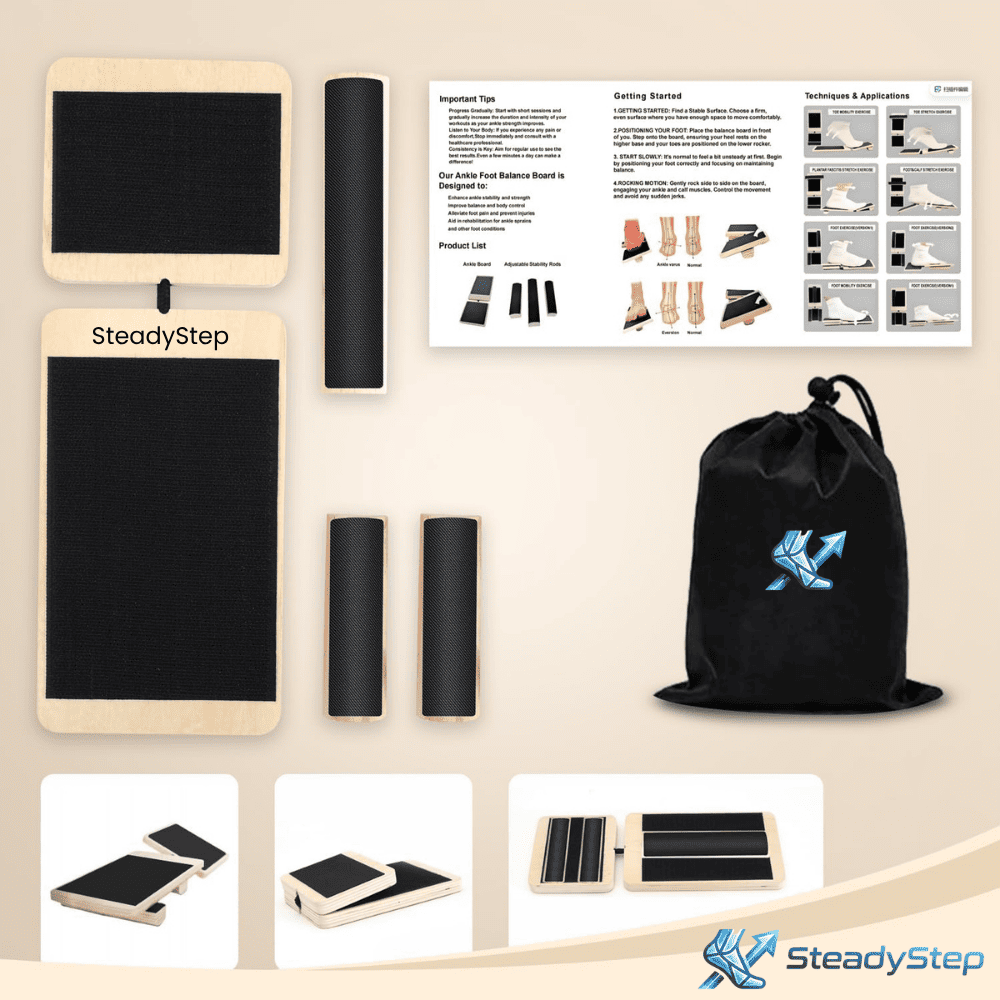
I really like this for ankle strengthening which is part of my exercise program. Very sturdy. Comes with a bag and diagrams for alternate placements of the bars that Velcro under the boards. Small board does the trick!
Why you'll love it
Why you'll love it
- 5 minutes a day to retrain how your ankle reacts
- Ends the rolling, the wobble, and the constant bracing for it
- A 4-week guide with four exercises and a clear finish
- Single-foot design forces the weak side to do the work
- Adjustable bars take you from wall-assisted to unassisted
- Supports up to 300 lbs — fits women's 5 to men's 13
What comes in the box?
What comes in the box?
Buy 1:
- 1x SteadyStep Board
- Travel bag
- E-guide - how to use the SteadyStep board
Buy 2 Get 1 Free!
- 3x SteadyStep Board
- Travel bag
- E-guide - how to use the SteadyStep board
- ToeBands 1x strong, 1x soft ($19 value)
Buy 3 Get 2 Free!
- 5x SteadyStep Board
- Travel bag
- E-guide - how to use the SteadyStep board
- ToeBands 1x strong, 1x soft ($19 value)
- Personal 12-week recovery program ($99 value)
Shipping information
Shipping information
We ship FAST and FREE! Every order above $50 includes Complimentary Tracked Shipping. All packages leave our facility within 24-48 hours on business days, getting your order to your home as quickly as possible
60-day guarantee
60-day guarantee
We stand by our product! That is why every purchase is backed by our 60-day money-back guarantee policy. Contact our support team Simply for an easy return. (3-hour average reply time from a real person)
Your long-term fix for foot & ankle issue
Your long-term fix for foot & ankle issue


Pick your problem. See exactly how SteadyStep board fixes it.
Five common foot and ankle issues. One board. A specific peg setup and protocol for each.

Your arch doesn't need support, It needs work
Chronic Foot Pain
This setup forces your arch and toes to do the work they were built for. Most people with plantar pain have never trained these muscles, that's why it keeps coming back.

Your Achilles doesn't need rest. It needs load
Achilles Pain
Your Achilles doesn't need rest. It needs load.Standing on an unstable back foot forces your Achilles to load and react constantly. That's the kind of controlled loading that fixes a weak, under-loaded tendon, the actual root cause of Achilles pain. Rest and stretching just quiet the pain for a few days.
Trains the ankle where it's most vulnerable
Ankle Sprains
Stacking the back pegs lifts your heel and tips your ankle into a toes-down position. That's the same position high heels force, and the position most ankles sprain in. Training there, under control, rebuilds the reflexes and the muscles outside your ankle. You're not just recovering. You're fixing what let it happen.
Builds Ankle Mobility That Actually Holds
Stiff Ankles
Your heel stays locked while your forefoot rotates side to side, driving your ankle deeper than you can reach standing flat. Stretching gets you flexible for a few minutes. Loading at end-range is what makes it last.
Strengthens Without The Flare-Up
Peroneal Pain
Your peroneals fire constantly to keep your foot from tipping side to side. You get stronger in their exact plane, without rolling your ankle into the position that sets off the pain.
Why Your Ankle Rolls — And How to Train It to Catch Itself
Your ankle is full of tiny sensors that tell your brain where your foot is. After a sprain, those sensors send the report late, and the muscles that should snap your foot back fire a fraction behind schedule. There's a moment where a roll is still recoverable, and a moment where it isn't — a late signal means you cross from one to the other before you can react. That's why a brace never fixes it: it catches the roll for you, so nothing underneath ever improves. SteadyStep puts one foot on a surface that keeps tipping, with no second leg to lean on and nothing to anticipate. Every small correction is one rep of the response your ankle currently makes too slowly.
You're not building a stronger ankle — you're building a quicker one.

Ready to fix your injury for good?
The SteadyStep board strenghtens your intrinsic foot & ankle muscles, offering faster, long-ter relief from injuries
Not all mobility boards are the same
See how SteadyStep wins against other boards.
| SteadyStep | Others | |
|---|---|---|
No apps needed |
||
DIgital guide and 8-week plan |
||
Single-foot design |
||
Adjustable pegs for progression |
||
60-day guarantee |
||
1 year warranty |
FAQs
Frequently asked questions
What does SteadyStep board actually do
What does SteadyStep board actually do
The SteadyStep helps improve foot strength, balance, and ankle stability by introducing controlled variability into your lower leg movement. That variability wakes up the small stabilizing muscles in your feet and ankles, which supports better mobility and joint control. Over time, this can help improve overall lower leg function, reduce stiffness, and support recovery from injuries like plantar fasciitis or ankle sprains.
What shoe sizes does the SteadyStep work for?
What shoe sizes does the SteadyStep work for?
The SteadyStep fits most adult shoe sizes comfortably — from about women's size 5 up to men's size 13. If you’re on the smaller or larger end, you might just need to tweak your foot placement a bit, but it’ll still work just fine.
Can I use it on hard floors or carpet?
Can I use it on hard floors or carpet?
You can use it on both! Just make sure the surface is flat and stable.
What makes this different from other balance boards or wobble boards?
What makes this different from other balance boards or wobble boards?
Most wobble boards focus on general balance, but they don’t train the small stabilizing muscles in your lower legs. The Stay this day is built for targeted single-leg training, helping you isolate and strengthen the muscles that support your feet and ankles. That means more control and better results — whether you’re recovering from an injury or working on improving your balance.
Can this help with my injury?
Can this help with my injury?
Very likely. The SteadyStep is designed to support recovery from a wide range of foot and ankle issues — especially when you're dealing with things like pain, stiffness, or instability. The included guide provides routines tailored to different injuries, helping you build strength, improve mobility, and move with more confidence.
How often should I use it?
How often should I use it?
3–5 times a week is a good place to start. Even just 5–10 minutes everyday can make a huge difference over time.
How long until I see results?
How long until I see results?
Many users begin noticing improvements in balance and muscle control within 1–2 weeks. Consistency is key — the more regularly you use it, the more noticeable your results will be.